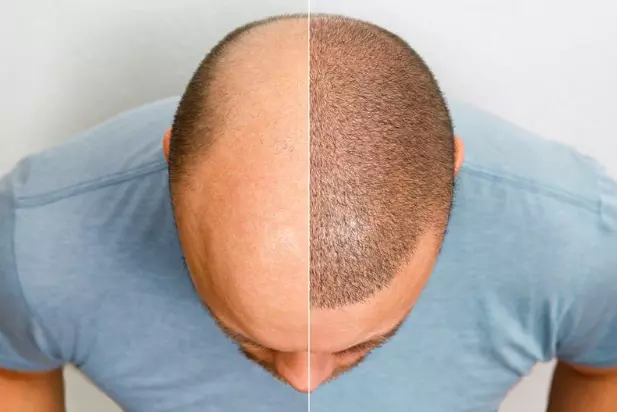
The Follicular Unit Extraction (FUE) procedure is identical to a FUT transplant in the way the follicles are placed in the recipient area. However, there is a difference in the way the grafts are harvested. The FUE hair transplantation is a more tedious procedure; follicles are individually removed from their original sites in the donor area or “safe zone.”
Follicular Unit Extraction (FUE) Hair Transplant Method
Follicular Unit Extraction (FUE) is a hair-transplant method in which tiny punches are used to separate each follicular unit from the surrounding tissue. Instead of removing a larger strip from which follicles are taken, Dr. Gray extracts individual follicular units one by one directly from the safe zone of the scalp. The harvesting process takes longer because it is much more tedious and labor-intensive than the FUT method.The donor sites where the follicles are removed are each about 1 millimeter in diameter, and they completely heal within seven to ten days. After all follicular units have been gathered, the grafts are transplanted to recipient sites just like in the FUT procedure.
The majority of Dr. Gray’s surgeries are FUE hair restoration procedures. Follicular Unit Extraction delivers all the results of FUT, but with the added benefit of reduced scarring and post-op pain. If you’re a good candidate interested in FUE, Dr. Gray will help you define the hairline and coverage that will make you feel great about your hair again.
Suitable Candidate for FUE Hair Transplant
People often wonder when they should go for the FUE hair transplant procedure. If you suffer from male pattern baldness, a receding hairline, or a thinning crown, it’s time to consider the FUE method for hair restoration.
It’s suitable for candidates with a dense donor area and those who want minimal scarring after the procedure.
Follows Unique FUE Hair Restoration Procedure
At Hair Transplant & Restoration Center, we take a unique approach to FUE hair transplantation. The focus remains on a personalized hair treatment, with an eye on delivering the best possible hair-growth results.
Personalized Medical Approach
Like any doctor, Dr. Gray will consider your preference, but he’ll ultimately recommend the solution that will give you the best results. There are some important points to consider when deciding where to do the FUE or FUT procedure, like: how short you plan to wear your hair in the donor area, how many grafts you need for the procedure, and the cost. Dr Gray’s goal is to do the right procedure for every patient and resolve the underlying condition, not just its symptoms.
Comfortable Procedure and Recovery Planning
Given our beautiful and serene location, it should be immediately apparent that your comfort is a high priority at Hair Transplant & Restoration Center. Besides making sure you are comfortable throughout the procedure, Dr. Gray is one of the very few hair transplant surgeons who are proactive about recovery before you even leave our office. After performing the FUE hair transplant for men, Dr. Gray administers a very long-acting local anesthetic, used in operating rooms, to help patients recover from surgery and decrease their dependence on narcotics. The pain relief lasts well beyond the end of the procedure; we have patients who drive themselves three hours home after surgery. Having dedicated 30 years to anesthesiology, Dr. Gray is keenly aware of your comfort and needs at every moment in your hair restoration surgery.
Attention to Detail and Patient-Centric Treatment
Constructing a hairline and mimicking a natural growth pattern is no small feat. In addition to being a skilled surgeon and anesthesiologist, Dr. Arthur Gray is also a talented artist. Passionate about helping people with his hair restoration expertise, he adopts a personalized treatment approach using advanced FUE hair restoration techniques.
Our Follicular Unit Extraction (FUE) Procedure:
At Hair Transplant & Restoration Center, we follow a step-by-step process to perform the FUE hair transplant procedure comfortably and achieve the best results.
Local anesthesia is used on the scalp to provide the patient with the most comfortable experience possible.
Small, circular incisions are made around a follicular unit in the donor area.
The follicular unit is extracted from the scalp.
Tiny incisions in the scalp are made for the recipient sites of the hair follicles using a fine blade.
Individual follicular units are placed into the recipient sites in the areas of hair loss.
A very long-acting local anesthetic is injected for prolonged pain relief after the procedure.
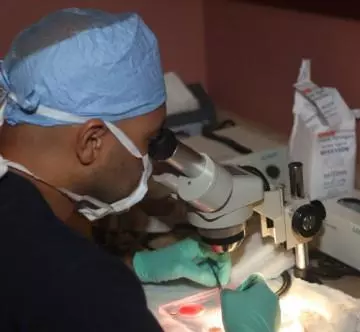
While Follicular Unit Extraction provides natural hair loss treatment results because of the size and precision of the surgery, the natural-looking aspect of follicular unit extraction is, in part, determined by the artistic ability of the doctor performing the surgery. During your consultation, Dr. Gray and his staff will take photographs and study your hair pattern to determine where the individual follicular units need to be placed in order to achieve the most natural-looking results.
Follicular Unit Extraction No Shave (FUE No Shave)
Dr. Gray also offers a variation of traditional FUE donor harvesting called FUE No Shave. Unlike traditional FUE, where the donor area is shaved with zero-guard clippers, FUE No Shave allows the surrounding donor hair to remain at its normal length. Instead of shaving the entire donor area, Dr. Gray carefully trims individual hairs that will be harvested using small scissors.
Because the surrounding hair remains long, the donor area is typically well concealed. Most people are unable to tell that a hair transplant was performed simply by looking at the back of the scalp, as they generally do not know what to look for. This is one of the primary advantages of the FUE No Shave technique. The clipped donor hairs grow back quickly; however, they will remain noticeably shorter than the surrounding hair for the first few weeks after the procedure, and the area will look thinned out.
FUE Recovery Timeline
The FUE transplant procedure shows faster recovery, and it starts within a few days of the operation date.
- The first week shows the formation of scabs around follicles in the transplanted area.
- From week 2 to 8, transplanted hair sheds, which is a part of the healing process.
- New hair growth begins around the 3rd or 4th month, with thin hair emerging that thickens over time.
- The real growth starts within 6-8 months, when hair density increases significantly.
- Finally, the newly grown hair blends with existing hair between 12 and 18 months after the FUE procedure.
FUE Hair Transplant Costs
The cost of FUE hair transplantation depends on several factors. The major factors include the extent of hair loss and the number of grafts required.
Book a consultation to determine the overall cost of the procedure.
Discuss Before You Decide
Dr. Gray appreciates that choosing your hair restoration surgeon is one of the most important decisions you are likely to face in your search for hair loss solutions. Using the FUE technique, Dr. Gray can harvest hair with either the traditional FUE or with the FUE No-Shave. He will be happy to talk to you directly to discuss your hair loss condition, your potential for FUE results, and any alternatives that might achieve comparable results. Contact us today for more information.
FAQs
1. What is the best FUE hair transplant option available?
The best FUE hair transplantation, shave or no shave, depends on the severity of hair loss, the hair density in the donor area, and the expectations for the procedure. It is important to discuss it thoroughly with your hair surgeon before choosing an FUE option.
2. What is the common range of FUE hair transplant costs?
The cost of an FUE hair transplant depends on the number of grafts required, the extent of hair loss, and the complexity of the procedure. Consult your hair transplant surgeon to get an estimate of the cost depending on your requirements.
3. What can I expect from FUE hair transplant before and after results?
Before going for an FUE procedure, you need to consult with your hair surgeon to understand your hair transplant requirements. After the transplant procedure, you’ll see hair growth within 6-8 months, and the hair density will improve within 12-18 months.